
Williamson County Criminal Court Cases
Williamson County divides criminal court cases by charge level. The District Clerk keeps felony files assigned among the 26th, 277th, 368th, 395th, 425th, 480th, and 512th District Courts. The County Clerk keeps Class A and Class B misdemeanor files for five County Courts at Law. A fine-only Class C charge or city ordinance case will usually remain with a justice or municipal court. Texas Penal Code Chapter 12 supplies the ordinary classification framework.
The court file begins when a prosecutor files an information for a misdemeanor or seeks a grand jury indictment for a felony. The clerk then records pleadings, settings, counsel appearances, motions, bond events, the plea, judgment, sentence, and later activity. Williamson County uses an appointed-counsel system described through Indigent Defense, not a single county public-defender counter. The booking shows custody; the case file shows how each count ended.
Seven Williamson County Felony Courts
Williamson County felony work is spread across seven numbered district courts, so the assigned court is part of a useful search result. The county directory lists direct lines for the 26th at 512-943-1226, the 277th at 512-943-1277, the 368th at 512-943-1368, the 395th at 512-943-1395, the 425th at 512-943-3380, and the 512th at 512-943-3881. The current county directory or court page supplies the 480th District Court contact.
The county's District Courts page identifies each court and links readers to pending case information. Its assignment and court-date details are practical clues, but the docket and filed papers remain clerk records. A sentence can also place a person under Williamson County CSCD, whose official page is shown below.
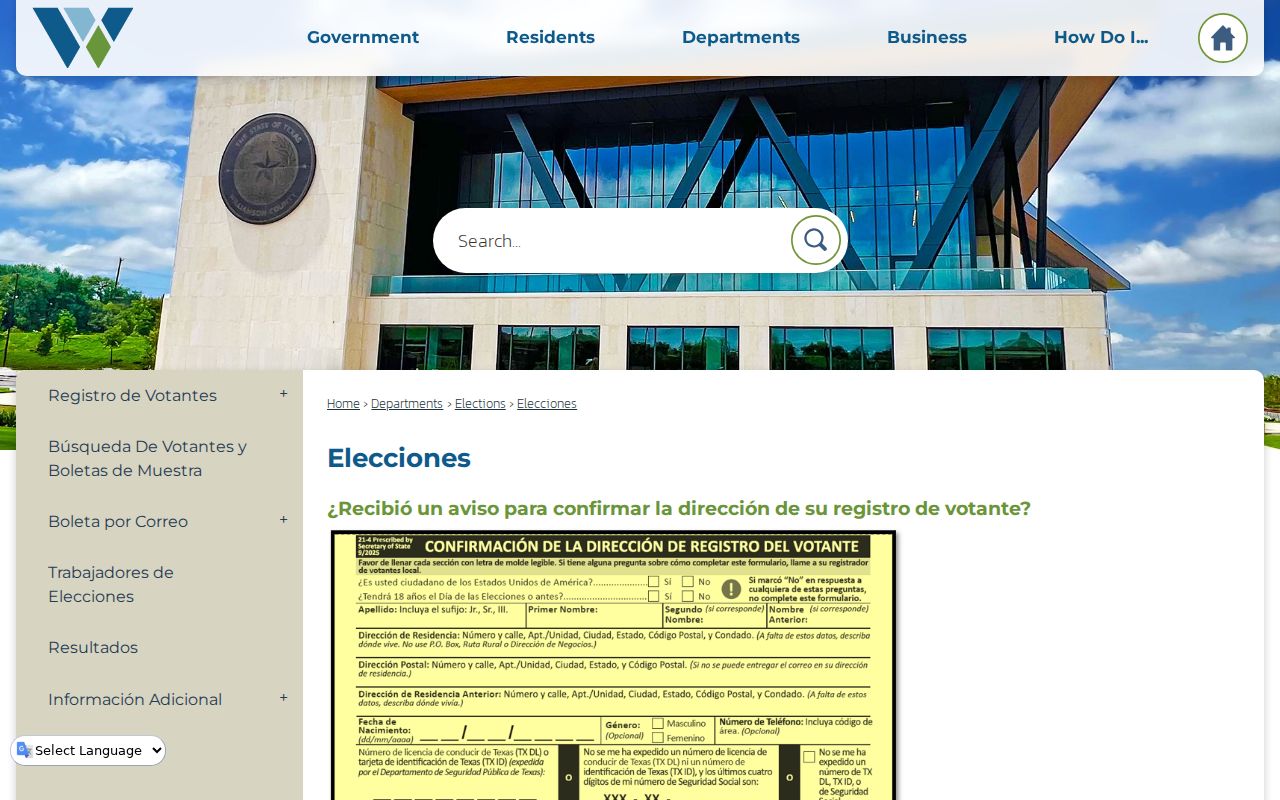
The court record can show community supervision, while private assessments and day-to-day supervision notes remain outside the public case file.
Searching Williamson County Case Records
The free Williamson County Public Judicial Records index is the best first stop for filed district and County Court at Law cases. Search with a cause number when one is known. A name search needs careful identity checks because common names, aliases, and spelling differences can return the wrong person or no result. Keep the filed date, assigned court, and charge in view before relying on a match.
- Choose the court or case-record route rather than treating the jail search as the same database.
- Enter the cause number, or use a surname and first name when the cause number is unknown.
- Narrow a broad result by filing dates, court, and any public date-of-birth field.
- Open the docket and read each charge, event, setting, and disposition separately.
- Send a copy request to the District Clerk for a felony or the County Clerk for a Class A or B misdemeanor.
| Field label | Type | Required | Use |
|---|---|---|---|
| Search or record type | Menu or tabs | Yes | Choose court records, not jail records. |
| Last name | Text | Name route | Try legal name, variants, and aliases separately. |
| First and middle name | Text | Optional | Narrows results but can also hide a match. |
| Date of birth | Date or text | Optional | May be suppressed or shortened in public view. |
| Case or cause number | Text | Alternative | Preserve the punctuation shown by the clerk. |
| Date filed or court | Date and menu | Optional | Helps separate names and court levels. |
Williamson County Certified Case Copies
An online docket is not always enough. A certified judgment, charging instrument, or order must come from the custodian. Williamson County emphasizes electronic District Clerk requests through its record and copy request form. Certified copies cannot be emailed; the clerk mails them or makes them available for collection. The office adds a $2 convenience fee to credit-card transactions, requires a $5 card minimum, and does not accept personal checks.
The District Clerk is at the Williamson County Justice Center, 405 Martin Luther King Jr. Street, Georgetown, TX 78626, and its main line is 512-943-1212. The County Clerk Courts Division uses the Justice Center and can be reached at 512-943-1515. Since August 1, 2026, the District Clerk has stopped accepting new walk-in customers after 4:30 p.m., though customers already being served may finish. Electronic requests avoid that cutoff.
Use the clerk's official request form and state the cause number, court, document, and certification need. A request for “the whole record” may cost more and take longer than a request for the judgment and disposition.
Inside a Williamson County Case File
A Williamson County criminal case file is organized around the cause, not the booking. The register of actions is a dated list of filings and court activity. It can reveal when counsel appeared, when a hearing was set, whether a capias issued, and when the court entered a plea, judgment, or sentence. Document images depend on public security settings and system integration, so a visible docket line does not guarantee a downloadable filing.
| Header | Cause number, filing date, case type, assigned court, status, and party display. |
|---|---|
| Charge | Description, level or degree, count, relevant dates, and posted disposition. |
| Parties | State, defendant, and public prosecutor or defense counsel information. |
| Docket events | Charging paper, counsel, bond, arraignment, motions, settings, plea, judgment, sentence, and capias entries. |
| Hearings | Date, time, assigned court, and hearing type when public. |
| Financial record | Court costs, fines, payments, and balance where exposed. |
| Restrictions | Protected identifiers, victim and minor data, and sealed, expunged, or nondisclosed material are withheld. |
Note: A public event line can confirm that a filing exists even when the filing image is not available online.
Reading Williamson County Case Outcomes
Every count needs its own outcome. A dismissal ends a charge without conviction, but it does not by itself erase the arrest or booking. An acquittal is a not-guilty result after trial or an equivalent ruling. Deferred adjudication delays a finding of guilt while community supervision is completed and can remain public through DPS unless a nondisclosure order applies. A conviction is the court's judgment of guilt and carries the sentence entered for that count.
- Information
- The prosecutor-filed charging paper commonly used for a Class A or B misdemeanor.
- Indictment
- A felony charging instrument returned by a grand jury as a true bill.
- Disposition
- The recorded result of one charge or the case.
- Capias
- A writ directing an arrest, often tied to a missed court event or judgment.
- Community supervision
- The Texas legal term often called probation.
For the final answer, ask the clerk for the judgment or disposition rather than relying on the arrest charge. The filed charge may differ from the officer's first allegation, and one case can mix convictions with dismissed counts.
How a Criminal Case Moves
A Williamson County prosecution generally starts after arrest and magistration, followed by prosecutor review. A misdemeanor moves forward by information, while a felony usually requires a grand jury indictment. Arraignment addresses the charge and plea. Discovery, motions, settings, plea talks, or a trial follow. The court then records the disposition and, when there is a conviction, the sentence. An appeal can add another layer outside the trial court's day-to-day docket.
Case flow: Charges Filed → Arraignment → Pretrial → Plea or Trial → Disposition → Sentencing
Article 15.17's rule that an arrested person reach a magistrate without needless delay and generally within 48 hours is not a trial deadline. It concerns warnings, probable cause, counsel information, and bond at the start of the process. Later case stages can take much longer and remain tied to each court's calendar.
Williamson Cases and re:SearchTX
re:SearchTX is the statewide e-file access system, but it does not replace Williamson County clerks. The Texas Judicial Branch record explanation directs the public to the relevant clerk because no single complete trial-court portal exists.
For a federal prosecution from Williamson County, use PACER because the county lies in the Austin Division of the Western District of Texas. Its federal court-record source page is shown below.
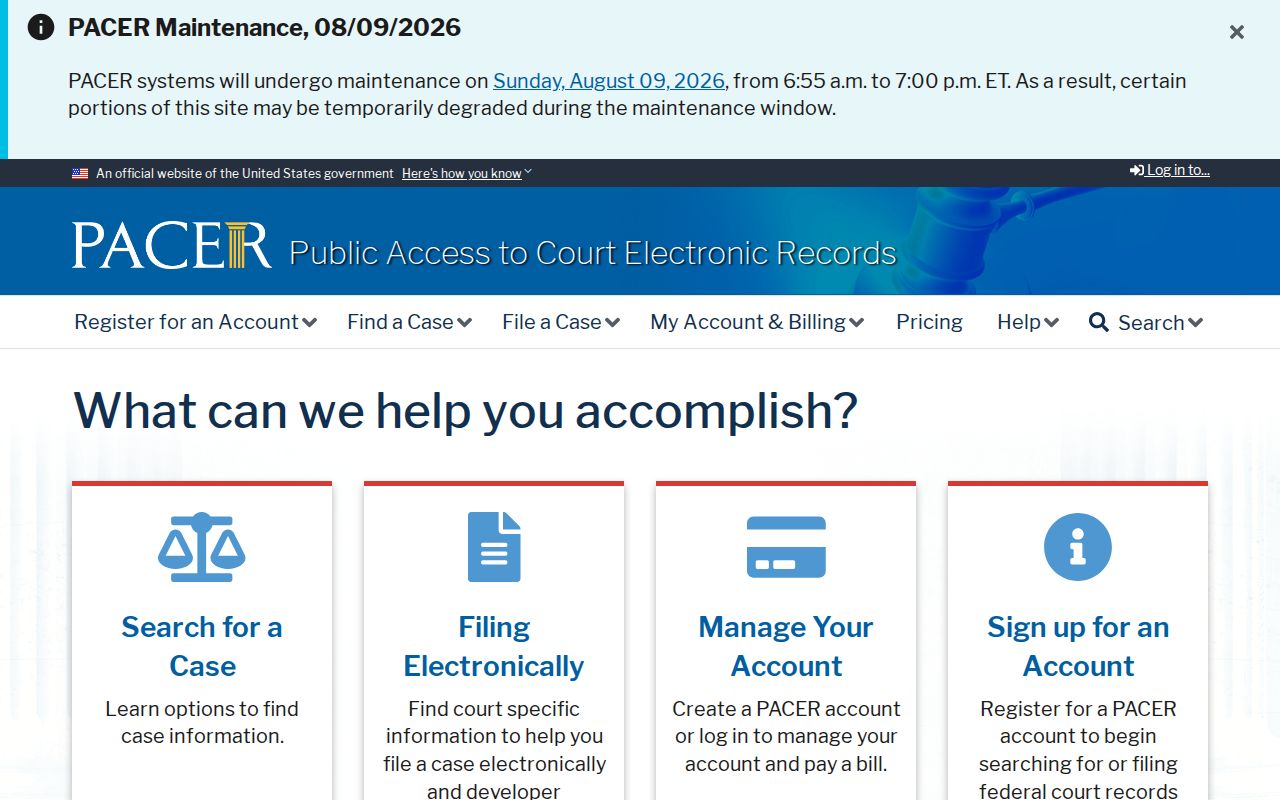
PACER does not replace the Williamson County index, and a missing re:SearchTX result should send a reader back to the District or County Clerk.
Williamson County Prosecutor Records
The District Attorney's Office prosecutes Williamson County felonies, but its public-information route is not the same as a clerk copy request. Written requests use the stated channel or mail or hand delivery to the Civil Division. Government Code Section 552.108 can limit release of prosecution material. The county's elected-official roster supplies current office terms, while the clerk remains the source for filed case papers.
The official District Attorney public-information page shown below explains that separate route.
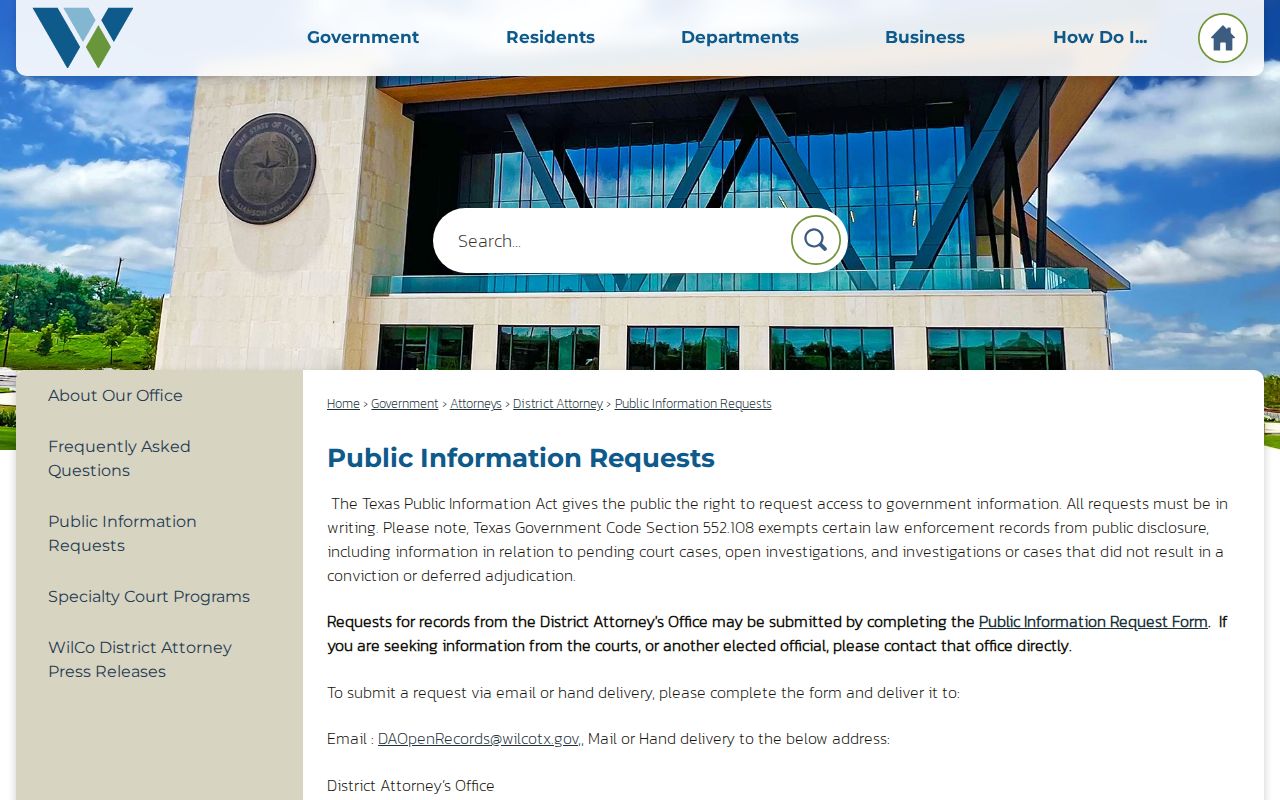
This split helps avoid sending a request for a filed judgment to an office that did not create the clerk's certified copy.
Case Record Access & Restrictions
Public access does not mean every Williamson County criminal court case document appears online. Sensitive identifiers, juvenile material, victim or minor information, and sealed, expunged, nondisclosed, or impounded records can be withheld or redacted. Active investigative material may also fall under Government Code Section 552.108. A public docket can show a hearing or filing while the document remains unavailable.
The Texas Public Information Act does not turn a clerk's adjudicative file into an ordinary county-agency record. Direct the court-file request to the clerk. If a case is missing, check spelling, filing date, municipal or justice jurisdiction, archive status, and legal restrictions before treating the gap as proof that no case exists.
The Texas Board of Pardons and Paroles source below represents a later decision layer that is separate from the trial court's judgment.
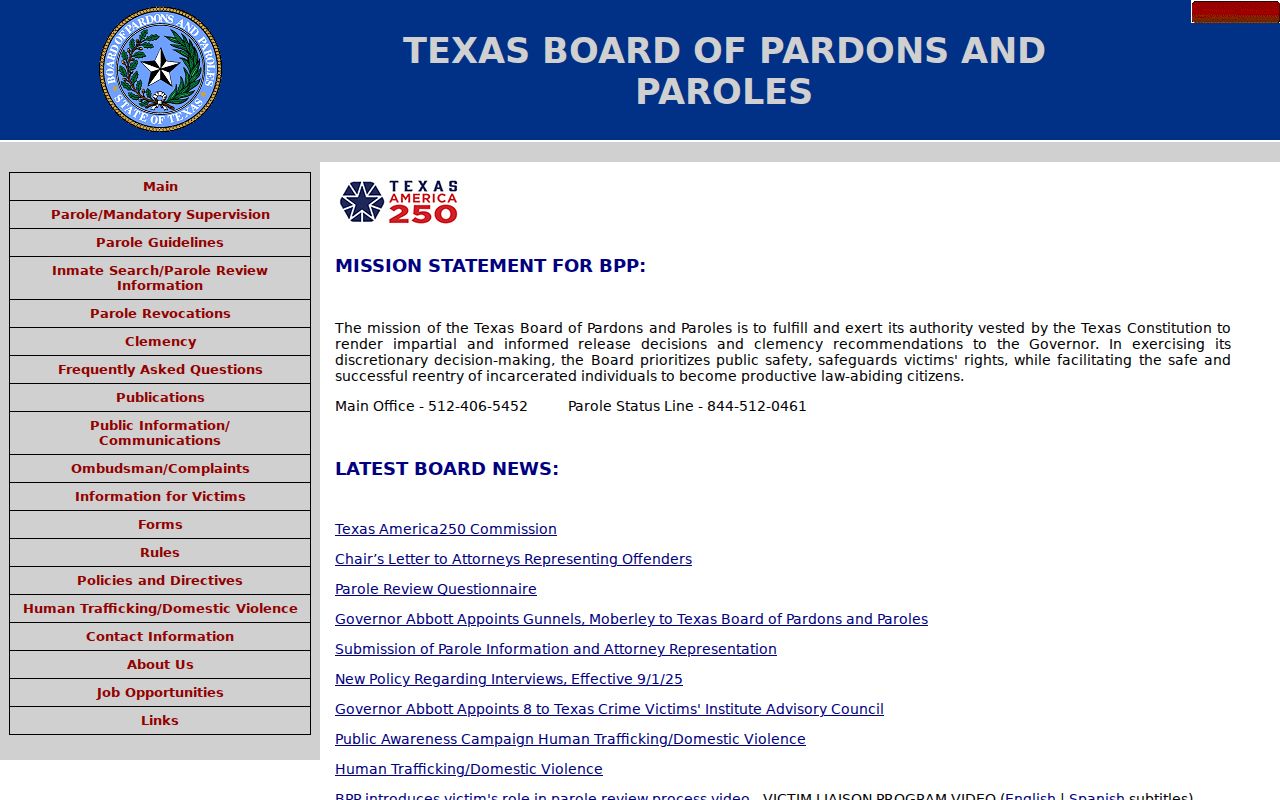
A parole decision or supervision record does not replace the Williamson County judgment and sentence that created the prison term.